
Polygraph Examinations & International Credibility Assessment
Confidential, professionally administered polygraph examinations for legal, corporate, safeguarding, domestic, therapeutic, and specialist investigative matters.
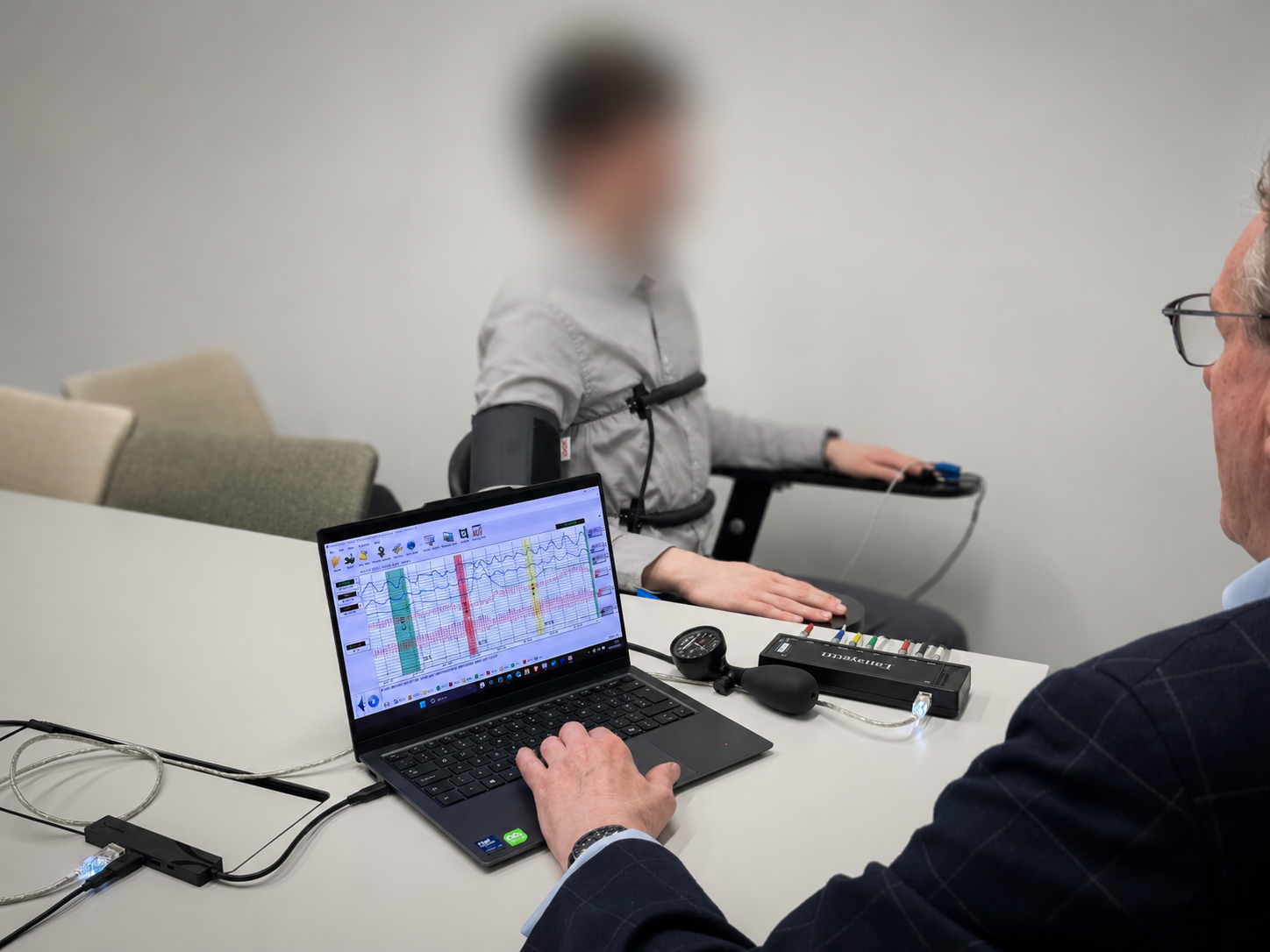
Every examination is conducted using advanced computerised physiological monitoring technology.
Polygraph in Global Practice
≈ 1 polygraph examination every 10 seconds worldwide
Estimated global frequency
6
per minute
360
per hour
≈ 8,640
per day
Estimated examinations since midnight (local time)
estimated examinations worldwide today
Indicative estimate based on published international polygraph utilisation data. There is no central worldwide registry of polygraph examinations.
For this counter, the Centre uses a conservative working estimate of approximately 3–4 million polygraph examinations annually worldwide, informed by published professional-association, governmental and academic utilisation data. No central international registry records the number of polygraph examinations conducted. On that basis, worldwide activity is estimated at approximately one examination every ten seconds.
The daily counter is calculated locally in the visitor’s browser from the elapsed time since local midnight. It is a statistical extrapolation and should not be interpreted as monitored or verified real-time data.
Who We Help
Providing independent expertise and scientifically grounded credibility assessments for complex scenarios.
Solicitors & Legal Teams
Assess the credibility of defendants and witnesses in criminal matters, ensuring alignment with investigative strategies.
Employers & Corporate
Mitigate risk through focused pre-employment screening and internal investigations of economic losses or insider attacks.
View Corporate ServicesSafeguarding Professionals
Support post-conviction sex offender management and child protection protocols with rigorous risk assessment.
View Safeguarding ServicesPrivate Individuals
Investigate disputed incidents in domestic scenarios professionally, objectively, and confidentially.
View Domestic ServicesClinical Referrers
Collaborate within therapeutic settings to assist with disclosure, substance misuse recovery accountability, relapse clarification and monitoring of sobriety in specialised addiction treatments.
View Clinical ServicesSports Integrity
Polygraph examinations to investigate breaches of sporting integrity, doping allegations, and match manipulation.
View Sports ServicesOur Polygraph
Examination
Services
24 Specialised Protocols

ASTM E52
100% Compliant
Committee E52 On
Forensic Psychophysiology
Domestic Polygraph Examinations
Domestic polygraph examinations are those in which the examinee and the examiner address specific issues that involve the credibility of statements regarding interpersonal behaviour between spouses, live-in partners, non-domiciled marital or intimate partners, children, parents, extended family members and blended family members. The purpose of this process is to investigate a disputed incident, not to address general suspicions or doubts. We recommend that all participants actively engage in counselling. The results of these tests are based on the interpretation of physiological data, so they are investigatory. Other evidence should be considered before taking action.
Learn MoreDomestic Abuse & Credibility Assessment
A specialist forensic service evaluating the credibility of disputed domestic abuse allegations — including physical violence, coercive and controlling behaviour, psychological abuse, and financial abuse. Available to solicitors, defence teams, and private clients.
Learn MoreCriminal Defence
Forensic / Criminal matters: such as homicide, sexual violence, theft, fraud, sabotage, espionage, and cases involving cyber psychology. Allegations of sexual abuse are subject to our enhanced service with two forensic polygraph examiners. The Centre for Forensic Neuroscience provides solicitors and lawyers with an assessment of the credibility of defendants and witnesses in criminal matters.
Important: polygraph findings are investigative and decision-support information. They do not determine guilt, innocence, liability, or the ultimate truth of any allegation. Findings should be considered alongside witness evidence, documentary evidence, expert evidence, digital evidence, and other relevant information.
Learn MoreSafeguarding Polygraph Examinations
We strongly support the child sex offender disclosure scheme, often referred to as 'Sarah's Law', which allows parents, carers or guardians to formally request the police for information about a person who is in contact with their child or a child close to them if they're concerned the person may be a significant risk.
Learn MoreTraining
Provide training/lectures on polygraph-related subjects.
Sexual Abuse and Violence
Polygraph examinations may assist in assessing the credibility and consistency of a disclosure or written statement made by an alleged victim of sexual abuse or violence. Findings are investigative in nature and should be considered alongside other available information and evidence.
Learn moreCorporate Misconduct
Structured corporate credibility assessment supporting organisations investigating fraud, theft, corruption, information leakage and workplace misconduct.
Corporate Investigations arrow_forwardEmployee Theft & Shrinkage
Specific-issue polygraph examinations supporting workplace investigations into employee theft, inventory shrinkage, cash discrepancies and internal loss.
Learn MoreInsider Attacks
Prevention, detection and investigations of insider attacks.
Sex Addiction – Clinical and Therapeutic Polygraph Examinations
The polygraph is used within a therapeutic setting to assist in disclosure, sobriety and relapses in sex addiction, as well as treatment resistance, etc. We receive referrals from various therapists who offer proven psycho-educational programmes for the treatment of sex and pornography addiction and support programmes for partners. Please note that we cannot be instructed in cases where the partner views a polygraph interview and examination as the only way of regaining trust (there must be additional sources). In addition, there must not be any evidence of punitive/vindictive motives as opposed to therapeutic considerations for seeking a therapeutic polygraph. We are associate members of the Association for the Treatment of Sexual Addiction and Compulsivity.
Learn MoreGambling Recovery Accountability & Financial Transparency Polygraph Examinations
Therapeutic polygraph examinations supporting gambling recovery, relapse disclosure, financial transparency, recovery-agreement compliance and trust rebuilding where compulsive gambling has caused uncertainty or concealed financial behaviour.
Learn MoreSubstance Misuse Accountability & Recovery Polygraph Examinations
Recovery-focused polygraph examinations for relapse disclosure, abstinence-accountability agreements, treatment or aftercare support, and trust rebuilding where substance misuse has affected families, clinical work, employment or professional responsibilities.
Learn MoreIndependent Quality Review
Providing independent quality control and second-opinion reviews of polygraph examinations (International).
Learn MorePre-Employment Advanced Screening Solutions
We provide focused pre-employment and organisational screening programmes designed to protect trust and mitigate insider risk. Screening is structured around behaviourally defined past conduct, with separate consideration of materially different issues where practical. Rather than operating as automatic pass/fail tests, significant responses or relevant disclosures can be progressed through structured clarification and more focused successive-hurdles examination (such as the TES, LEPET, or BOIST) where required.
Learn MorePaired Testing (Marin Protocol)
When two individuals provide contradictory accounts of the same event, independent polygraph examinations may provide additional investigative information to assist decision-makers. This approach is particularly effective in mediation contexts and disputed allegations.
Learn MoreWrongful Convictions and Appeals
Limited pro bono polygraph examinations may be considered for individuals who have been granted leave to appeal a conviction. A polygraph result does not itself establish a ground of appeal and must not be regarded as a substitute for admissible evidence or legal argument.
Learn MoreImmigration, Sham Marriages and Asylum
Polygraph examinations may assist legal representatives and decision-makers by assessing the consistency and credibility of specific statements within an immigration, sham marriage, or asylum matter. Findings are investigative in nature and should be considered alongside documentary evidence, interview records, country evidence, witness evidence, and other relevant information. A polygraph examination does not determine asylum validity or conclusively verify the truth of a claim.
Learn MorePost-Conviction Sex Offender Credibility Assessment
To effectively manage sex offenders in the community. Examinations for Denial, Sexual History and Maintenance/Monitoring, which is conducted in conjunction with Therapists and Probation Officers. The main aim of Post Conviction Sex Offender Polygraph Testing (PCSOT) is to keep the public safe. The process may assist professionals in identifying, monitoring, and managing risk-related disclosures and compliance issues. Maintenance and monitoring examinations may use validated screening formats such as the British One-Issue Screening Test (BOIST). This helps professionals to better manage and treat convicted sex offenders in the community.
View PCSOT ServicesIntelligence Verification
Polygraph testing to assess the value of critical intelligence sources.
Sports Integrity Credibility Assessment
Dr Keith Ashcroft has experience in forensic credibility assessment and sports integrity matters, including allegations involving doping, match manipulation, and breaches of sporting regulations. He has provided expert witness testimony at the Court of Arbitration for Sport (CAS).
Learn MoreEsports Polygraph Services & Integrity Investigations
Evidence-led specific-issue investigations and focused integrity screening programmes for esports operators, teams, leagues and betting-content providers. Screening is structured around clearly separated, behaviourally defined issues with successive-hurdles follow-up rather than simplistic pass/fail metrics, integrated with wider investigative evidence.
Esports Polygraph Services & Integrity InvestigationsExpert Witness Testimony
Dr Ashcroft specialises in providing expert witness testimony internationally on matters relating to credibility assessments and their related technologies.
Media & Film Set Hire and Consultation
We have extensive experience collaborating with major film directors, including Oliver Stone (known for films such as Snowden), while working internationally and offering reliable services like polygraph examinations for various professional needs.
Learn MoreFishing Tournaments
We apply polygraph examinations to investigate competitor rule violations.
Ready to discuss your matter?
Request a Confidential ConsultationHow The Consultation Works
We operate under a strict ethical framework. To guarantee the highest standards of accuracy and confidentiality, there is no instant online booking.
Initial Enquiry
Contact us by phone, email, or our secure enquiry form. We will discuss your matter confidentially and advise whether our services are appropriate for your situation.
Suitability Review
Before an examination is arranged, we consider medical, psychological, communication, consent and safeguarding factors. You can discuss these with Dr Ashcroft directly or complete our optional confidential pre-screening questionnaire in advance.
Complete Optional Pre-ScreeningExamination Planning
Upon acceptance, we schedule the examination at a suitable neutral location, finalise question formats, and provide preparatory materials. Learn more about how examination questions are formulated.
Preparation & Process
A transparent, step-by-step psychological assessment framework. We ensure all examinees fully understand the process, promoting maximum reliability.
Pre-Test Consultation
We review background case facts, confirm medical and psychological suitability, and explicitly discuss privacy, confidentiality, and consent boundaries before any testing begins.
The Pre-Test Interview
The most critical and comprehensive phase. The examiner thoroughly discusses every question to be asked during the exam.
Data Collection
Specialised, non-invasive sensors are attached to record biometric data (respiration, electrodermal activity, cardiovascular parameters) while the exact agreed-upon questions are asked.
Analysis & Report
The examiner analyses the physiological data using recognised forensic scoring methods. The findings are then communicated in accordance with the agreed scope of the instruction. Where a written report forms part of that scope, a confidential professional report is prepared.
Pre-Screening and Safeguarding Review
Our optional pre-screening questionnaire helps identify factors that may require discussion before a voluntary polygraph examination is considered, including health, communication, consent, and safeguarding considerations.
Completion of the questionnaire is not required and does not determine eligibility or outcome. These matters can also be discussed during an initial consultation.
Helping You Get the Best from Your Examination
A polygraph examination is a structured psychological assessment that relies on clear communication and stable physiological recording. These simple recommendations help ensure the examination proceeds comfortably and that the data collected are of the highest possible quality.
Before You Leave Home
Be well rested. You do not need to prepare in any special way, but arriving after a normal night's sleep will help you remain focused throughout the assessment.
Maintain your usual routine. If you normally drink tea or coffee, keep consumption moderate rather than excessive. Continue taking prescribed medication unless your doctor has advised otherwise, and let your examiner know about any medication you are taking.
Have something light to eat. A normal breakfast or light meal is recommended. Being uncomfortably hungry can make it harder to concentrate during a lengthy assessment.
Bring anything that may assist the consultation. If there are documents, timelines, agreed issues, or other information that helps define the examination scope, please bring them with you.
When You Arrive
Plan to arrive a little early. Allowing yourself a few extra minutes avoids unnecessary rushing and gives time to settle before the consultation begins.
Please bring photographic identification. Identity verification forms part of our examination and reporting procedures.
Feel free to attend with a companion. If it makes you more comfortable, a family member or friend is welcome to accompany you to the venue. They will be invited to remain in the waiting area while the examination is conducted privately.
Choose practical, comfortable clothing. The examination uses non-invasive recording equipment positioned over normal clothing. Comfortable attire simply helps you remain relaxed throughout the process.
Advanced Investigative Methodologies
Most enquiries are appropriately addressed using a conventional polygraph examination. Certain investigations, however, may benefit from additional evidence-informed methodologies selected according to the specific investigative objectives and available evidence.
Concealed Information Test (CIT)
A recognition-based methodology that evaluates whether an individual recognises specific, non-public information rather than measuring responses to direct accusations.
- •Assesses recognition of non-public information
- •Suitable where details are known only to those with direct knowledge
- •May complement conventional polygraph examinations
Investigative Memory & Cognitive Mapping
Structured memory retrieval and spatial mapping techniques that help organise and evaluate recalled information where appropriate.
- •Missing persons and body recovery
- •Concealed property and location identification
- •Movement and route reconstruction
Specialist International Investigations
Supporting suitable investigations with an international dimension, assessed on their merits for each jurisdiction and circumstance.
- •Cross-border and international enquiries
- •Interpreter-assisted examinations
- •Humanitarian, corporate and government investigations
- •Spain (Madrid, Barcelona, Málaga & Marbella)
British One-Issue Screening Test (BOIST)
A UK-developed directed-lie screening format designed for single-issue investigations, using repeated presentations of one relevant question across multiple charts to maximise statistical reliability.
- •Single-issue focus with directed-lie comparison questions
- •Validated for screening, monitoring and maintenance contexts
- •Adapted from the Air Force Modified General Question Test (AFMGQT)
Scientific Foundations
The Centre for Forensic Neuroscience applies evidence-informed investigative methodologies appropriate to the circumstances of each case. Conventional polygraph examinations, the Concealed Information Test (CIT), the British One-Issue Screening Test (BOIST), structured interviewing and other recognised forensic techniques may each have a role depending upon the investigative question being addressed. Dr Keith Ashcroft has received specialist training in the CIT through Japan's National Research Institute of Police Science (NRIPS), the scientific research institute of the National Police Agency of Japan, which has made internationally recognised contributions to research into psychophysiological detection of concealed information.
Research & Method Development
The Centre also develops structured assessment-support and research tools through Credibility Systems, including resources for question construction, disclosure review, Bayesian reasoning and professional documentation.
Explore the Credibility Systems research platformReady to Discuss Your Matter?
Contact us for a confidential consultation. We will discuss your situation and advise on suitability, scope, and next steps.
Frequently Asked Questions
Request Professional Review
Submit a guided examination request for review of suitability, scope, location and appointment requirements, or ask a confidential question first.
Important Notice for Legal Professionals
Polygraph examinations are investigative and decision-support tools. They do not determine guilt, innocence, liability, asylum validity, or the ultimate truth of any allegation. The Centre for Forensic Neuroscience does not represent polygraph findings as conclusive proof of any disputed fact. Findings should be considered alongside witness evidence, documentary evidence, expert evidence, digital evidence, clinical information, safeguarding information, and any other relevant material. Each instruction is subject to suitability, voluntariness, scope definition, and ethical review.